
Lynda takes us through some of the Progymnasmata, exercises in building presentation skills.
One of my assignments during the first term of my MRes in Rhetoric and Oratory was an exercise from the Progymnasmata (preliminary exercises) which formed part of the curriculum for boys and young men in the ancient Greek and Roman world. Despite being an early exercise for such boys and young men, it was still surprisingly challenging for me!
The first record of formalised preliminary exercises was in the 1st and 2nd centuries AD, though many individual exercises that later became the rhetorical curriculum had been taught and practised far earlier. Indeed, the handbook ‘Rhetoric to Alexander’ (originally attributed to Aristotle but believed by modern scholars to have been written by Anaximenes of Lampsacus), estimated to have been written between 340 and 338 BC, contains at least one reference to Progymnasmata.
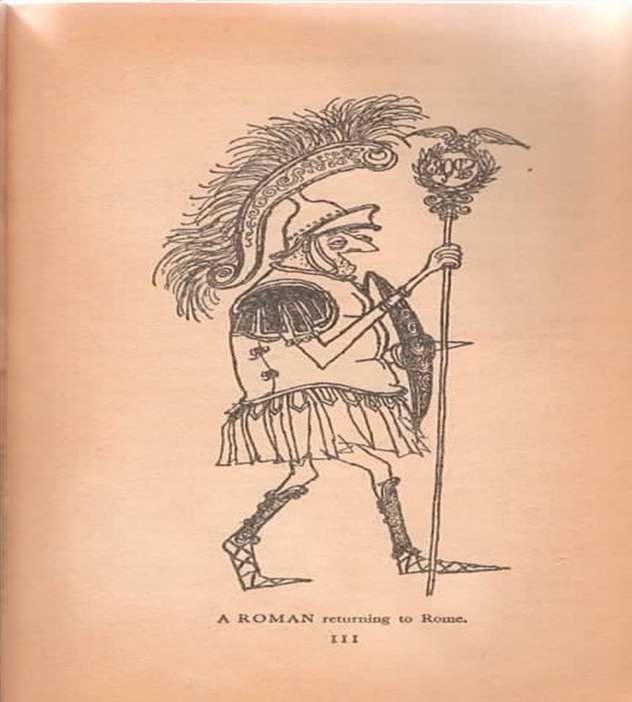
Source: LRW from “Down with skool”1
These exercises evolved, as can be seen from pedagogical texts by rhetoricians such as Quintilian and Cicero.
For example, an early form of the exercise around a Commonplace Topic (koinos topos/locus communis) was simply to amplify an accepted fact. Another example was Thesis, an exercise to prepare and deliver a complete argument on a general issue.
Later, the Commonplace Topic exercise was adapted to be used for facts that might be disputed, allowing boys to learn how to argue both sides of a point. They would have done this in an early exercise, where they were tasked with arguing for and against a specific question (anaskeue kai kataskeue/conformatio et refutatio).
For this SpeakUp!, I am keeping it simple as well as light-hearted, so a festive theme appealed. I thought I would closely follow the formula of one of the ancient Greek rhetorical exercises. The theme of Christmas seemed to fulfil the criterion of being both seasonal and a Commonplace Topic (koinos topos), so here goes!
My Commonplace Topic: Christmas
Christmas is celebrated by many people throughout the UK and the world. For some. it is a religious observation where the priority is to give thanks for the birth of their saviour, Jesus Christ, from where the name originates. It begins on the first Sunday of Advent, which usually falls at the end of November, and ends with Epiphany, or Three Kings Festival, on 6th January. The latter is a popular celebration in Roman Catholic and Christian Orthodox countries. Some leave the exchanging of gifts until this date.
For others, Christmas holds no religious meaning; instead it is simply a time to catch up socially face-to-face with colleagues, enjoying the company of good friends and spending time with close family members on Christmas Day. Some people maintain the tradition of writing cards, posting them at the beginning of December: others wait until closer to Christmas Eve. The sending of virtual Christmas cards by email became more popular a number of years ago. These often feature beautifully-designed animated graphics of snow, Santa Claus and reindeer!
Many people put up decorations, including what has become the star of the show; an evergreen conifer tree, large or small, where they hang baubles and fairy lights. Again, there is dispute on when decorations should be put up and taken down! Some are even superstitious about the latter, insisting that it is bad luck to have decorations up after Twelfth Night. Decorations are often taken out of boxes in cupboards and lofts annually, and for some families the hanging of small ornaments around the house and on the tree has become a much-loved ritual. For some, it has become a tradition to add one or two new decorations to their collection. There are some delightful novel tree decorations out there: felt reindeers, elves, polar bears, angels and fairies. There are even baubles in the form of miniature aubergines, sprouts and peas in a pod! Christmas trees can sometimes seem like a sort of competition, proudly displayed in full view for anyone to see – or at least those who walk past the living room window.

Photo by Felicia Buitenwerf on Unsplash
Christmas also seems to be a time for a month’s over-indulgence for very many of us. In the UK, we are spoilt for choice when it comes to seasonal treats. Not only do we have a wide selection of the home grown variety, such as turkey, whisky, stilton and mince pies, we now also have access to an array of goodies from our European neighbours. Some of my favourite Christmas sweets hail from Germany, such as lebkuchen and stollen!
The office Christmas party has become a bit of an institution. These can range from an intimate gathering of team members in the local pub to a large and lavish themed party with professional caterers and DJs. As these were seriously curtailed for the last two years due to the coronavirus pandemic, it seems even more important this year to celebrate with those who are still with us and remember those who are now departed.
Sadly, there are too many for whom Christmas is a stressful time. This might be due to a lack of money that means they are not even able buy a proper meal, let alone buy presents. Or it may be because their nearest and dearest are long gone, and no friends or family with whom to celebrate. Thankfully, there are always those who are kind and generous enough to donate their money or time to those less fortunate than themselves. This epitomises the Christmas spirit: The sharing of love and joy however we are able to, according to our means.
Wishing you all the best for the New Year – and 2023!
By Lynda Russell-Whitaker
Footnote: Here are the Progymnasmata listed by Aphthonius of Antioch, (Source: Wikipedia):
- Fable (mythos)
- Narrative (diēgēma)
- Anecdote (chreia)
- Maxim (gnōmē)
- Refutation (anaskeuē)
- Confirmation (kataskeuē)
- Commonplace (koinos topos)
- Encomium (enkōmion)
- Invective (psogos)
- Comparison (synkrisis)
- Personification (ēthopoeia)
- Description (ekphrasis)
- Argument
- Introduction to law (nomou eisphora).