
Some helpful communication lessons from recent, high profile police investigations:
- Be very conscious of the importance of Trust in spoken communication, and ensure you maintain it.
- When in Crisis Mode, don’t go silent and create a vacuum, even if it’s uncomfortable to speak.
- Learn from your own – and from others’ – mistakes.
- Your Spoken Communications need to be very clear.
- Social Media is now your judge and jury.
Police forces around the world have come under increasingly critical, public scrutiny. Cases such as George Floyd (USA), Sarah Everard and Nicola Bulley (UK), and P. Jeyaraj & J. Beniks (India) have helped create difficult operating environments for the Police in those nations.
In this context, police forces must aim for what is a difficult communication balance: What is truly in the public interest to share, and what merely interests the public?
There’s a demanding dynamic between the need for secrecy/privacy, e.g. for the victims, their friends and families, vs. the sometimes conflicting need to engage with the public to elicit vital information, often from unwitting or reluctant witnesses, and often sought via the media in order to reach the widest audience most quickly.
Regardless of the many practical difficulties surrounding police incidents, effective and persuasive communication often remains paramount, just as it does in business and elsewhere.
The media do help the police, as this also meets their voracious ongoing need to fill 24/7 news feeds – but only up to a point, as the media also have their own agendas, e.g. to secure (rare) “scoops”, a unique angle or headline, or better still a controversy.
You might therefore expect effective and persuasive communication to be an area of significant focus and investment for key police officers. But such high profile cases are thankfully rare, so few investigators get to become sufficiently well-practiced. Alas, they typically find this out the hard way…
Few would reasonably expect the very early stages of police investigations to show significant progress. Yet progress (or its absence) is precisely what the public want: What are the police doing? Is it enough? What aspects of a case are they staying tight-lipped about? Have they missed key clues? I bet I could do a better job, and so on.
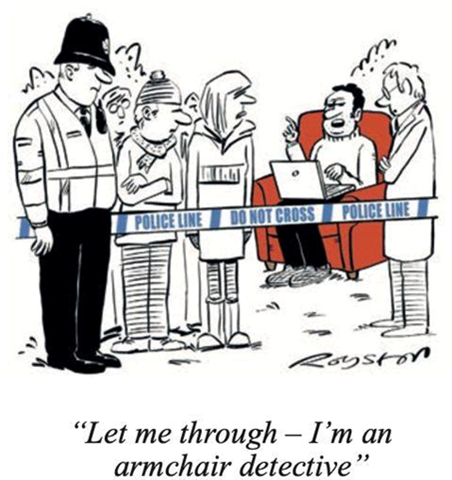
Image source: roystoncartoons.com, www.private-eye.co.uk (approval given for GPB’s reproduction)
Where has this hyper-critical trait come from? I doubt anyone really knows, but there’s a clue from our obsession with crime fiction. Agatha Christie is the world’s most-translated author and the world’s favourite fiction writer of all time, with over 2 billion copies sold. Yet she’s just one author in a densely crowded segment. The detective series ‘Beyond Paradise’, ‘Death In Paradise’, and ‘Endeavour’ all figure amongst the top 6 UK TV shows. Each is more widely watched than even the most popular soap operas1.
Interest in “Cold Case” and Forensics TV dramas has also developed (in the UK, for instance, ‘New Tricks’ and ‘Silent Witness’, Scandi Noir dramas such as The Killing and The Bridge, and from the USA, Bones and CSI [name your City]).
Silent Witness (expertly parodied as ‘Witless Silence’2) is broadcast in more than 235 territories and has survived for 26 series and 228 episodes. That’s quite a coup given its claustrophobic and repetitive dramatic setting.
The successful and relatively low-cost US show ‘Making a Murderer’ (20 episodes, 2015-’18) has spawned many imitators, investigating true-life miscarriages of justice. Particularly during the Covid lockdown era of box-set bingeing.
There is clearly a sceptic / detective /pathologist in many of us! They are a professional investigator’s nightmare, creating a communication minefield demanding careful navigation.
I’ll use the recent UK police investigation of Nicola Bulley as a case to examine. The police communication related to it was described by one headline as a ‘Car crash’3.

The River Wyre, near the site where Nicola Bulley’s dog and phone were found10.
I’ll omit most case details, since extensive coverage is easily found elsewhere. What can we learn here to apply beyond the world of criminal investigation?
First there is the benefit of specialist Crisis Management coaching and practice, already mentioned above.
Oddly, I first heard of this case through Social Media, via a direct Missing Person appeal from a concerned friend, on LinkedIn.
Next, it’s vital for figures of authority to understand better how to be persuasive, and for these Police cases in particular, how to (re-)build trust.
Persuasion leans heavily on Ethos, Pathos and Logos (see image below), first identified by Aristotle c. 2,400 years ago. They can be roughly translated as Trust, Emotion and Logic.
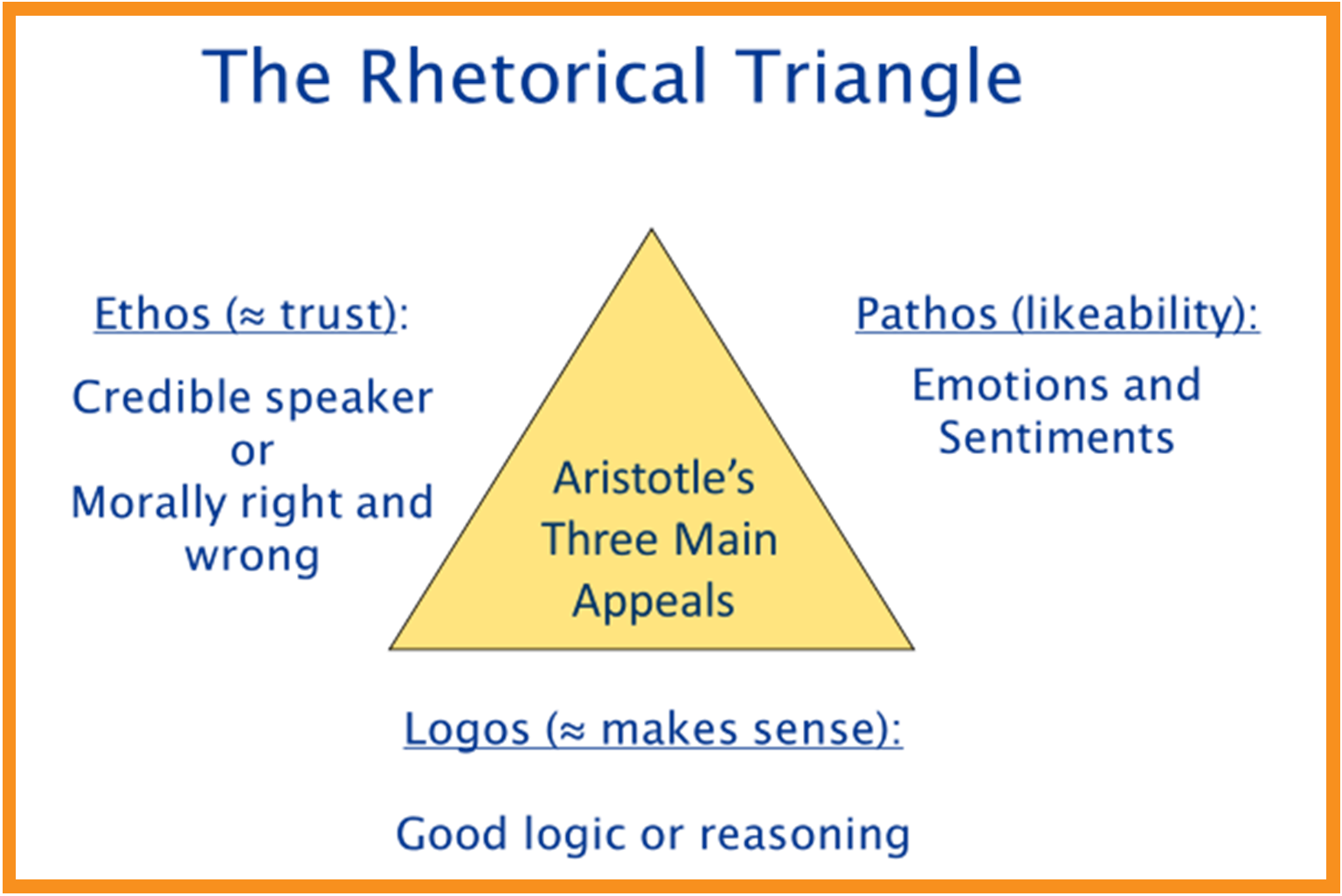
Image source: GPB
Trust Enablers include showing honesty and openness. Most of us instinctively recognise and emphasise them ourselves. This pays dividends because if we trust someone we are more likely to consider then accept their logical case. Without trust, the other Appeals tend to fail.
Much scientific research11, 12 supports the idea that establishing trust is a pre-requisite for effective persuasion, while withholding information (even out of perceived necessity) creates a barrier. So be open and honest with an audience. Otherwise, they’ll likely recognise you’re being “economical with the truth”, with negative consequences for effective persuasion. This was an obstacle for the Police in these cases.
In the Nicola Bulley case, early Police statements were strong on appealing to Pathos (concern about a missing woman) and to Ethos (what is morally right i.e. helping to find her). This set off the desperation for news updates. They were less strong on being open and honest – on sharing what they knew about the potential cause of her disappearance. When the police shared their early “working hypothesis” that Nicola had entered the river at her last known location, it caused widespread disbelief. Why?
Well, important facts were initially withheld: the police had had recent contact with Nicola and considered her “vulnerable” and a “high risk”. We only learned later that they had “looked at and discounted every potential suspicious or criminal” angle in her disappearance4. Unlike the public, they sought witnesses, not suspects…
The Economist later summarised this in their ‘Social Media Sherlocks’ article: from early on, ‘Lancashire constabulary had a good idea about what happened to her, even if they weren’t telling us. The implicit message was: trust us. But the public simply couldn’t… confidence in police, especially when dealing with women, is at a low’5.
The information vacuum quickly led to an army of ‘keyboard warriors’ pronouncing multiple unfounded crackpot theories about Nicola’s associates, location and fate, fed by a diet of detective fiction, which routinely normalises the wildly implausible. Consequences included a rapid escalation of the wrong sort of public interest, voyeurs speculatively descending on the scene, false information and abuse.
This all made the Police’s task more difficult and resource-hungry. Det Supt Becky Smith said she’d “never seen anything like it6” meaning the levels of social media coverage of this case, in her three decade career.
The public interest became a social and main media story, acquiring a virtual life of its own. Once this destructive social media “genie” was out of its bottle, the Police then retreated, seemingly unsure about their best next steps.
Into this silent vacuum, The Guardian stated, ‘diver Peter Faulding arrived’6. He was incorrectly championed by the media as an expert witness with inside knowledge. The same article later expanded, without irony or self-reflection, he ‘gave updates multiple times a day to the eager press… and Lancashire constabulary struggled desperately to keep control of the narrative’6. The Police had not hired him in the investigation. Should journalists not have clarified their source’s status?
During such crises, there’s a huge hunger for information updates, so it’s important to update proactively. Remember the daily Covid updates, anyone? Otherwise, “alternative facts” unhelpfully fill the void, prompting further speculation that quickly spirals out of control.
Only six hours after withholding Ms Bulley’s vulnerabilities as being “personal and private”, the Police performed a massive U-turn, revealing that she had “significant issues with alcohol” arising from “ongoing struggles with the menopause3”.
Much criticism then focused on Police motives for having violated the victim’s privacy: ‘purely to discredit her as a rational actor and re-situate her disappearance away from the realm of mystery, back in the realm of the expected. It… reinforced the sense of institutional misogyny within policing as a whole’7. The Police thus further eroded public trust, leaving a Rhetorical Triangle in tatters.

Image credit: manshagraphics
The Independent newspaper captured it neatly: ‘If the public cannot trust how the police handle the release of information, why on earth should they trust their investigations?8’.
Ouch… So what can we all learn from this tragic case?
I guess we have to start bluntly with this: if YOUR audience doesn’t believe you’re being honest with them, why on Earth would they trust you? So focus on building credibility and trust first.
How we communicate verbally and vocally informs the way we’re perceived, and that means we should all focus on what you look like and what you sound like, not just what you say. They must all align (we use the word ‘congruence for that).
The Police’s communication errors should be a salutary reminder for us all of the fundamental need to establish and maintain – and retain – trust.
When we’re required to persuade others, we ought to avoid the mistakes made in ‘the biggest communications disaster ever cobbled together by a British police service’8.
Don’t you just hate it when all your good work is overlooked or unappreciated? Bad communication largely obscured the finding that the Police’s initial working theory in this case, the logic (Logos) part, was correct all along. Despite that, it was not the Police who found Nicola’s body, but a member of the public, Two weeks after she entered the water and less than a mile downstream.
The Lancashire Police will now come under close scrutiny from the College of Policing, the Information Commissioner’s Office (ICO), the Independent Office for Police Conduct (IOPC) and others. These are further huge distractions and resource costs which could have been avoided, with more focus on Communication basics.
Andrew Snowdon, Lancashire’s Police and Crime Commissioner agreed: “there remain questions about… how it was communicated… lessons can be learned9”.
We would ALL do well to learn from those lessons.
By Des Harney
References/Image sources:
- https://www.thinkbox.tv/research/barb-data/top-programmes-report/
- https://www.imdb.com/title/tt0582908/
- https://www.theguardian.com/uk-news/2023/feb/16/car-crash-police-communications-on-nicola-bulley-case-fuelled-speculation
- https://www.liverpoolecho.co.uk/news/liverpool-news/police-discount-potential-criminal-element-26181111
- https://www.economist.com/britain/2023/02/21/nicola-bulley-and-the-era-of-the-social-media-sleuth
- https://www.theguardian.com/uk-news/2023/feb/19/polices-poor-communications-on-nicola-bulley-case-are-a-lesson-for-other-forces
- https://www.theguardian.com/commentisfree/2023/feb/20/nicola-bulley-family-social-media-public-police
- https://www.independent.co.uk/voices/nicola-bulley-alcohol-issues-lancashire-police-b2284141.html
- https://www.lep.co.uk/news/lancashires-police-and-crime-commissioner-announces-full-independent-review-into-handling-of-nicola-bulley-case-4037541
- Free to use source: https://upload.wikimedia.org/wikipedia/commons/5/58/River_Wyre_-_geograph.org.uk_-_3925633.jpg
- Milliman and Fugate, 2013: Using Trust-Transference As A Persuasion Technique: An Empirical Field Investigation, Journal of Personal Selling & Sales Management.
- Ahmad and Ali, 2018: A Study on Persuasive Technologies: The Relationship between User Emotions, Trust and Persuasion, International Journal of Interactive Multimedia and Artificial Intelligence.