
A broader look at what to do with any tough question
One of the more frequent topics that we have covered in coaching clients these past few months has been ‘answering the question’ or ATQ as it is so well known.
Usually this centres around the toughest questions that a client might get from one of their audiences such as shareholders, clients, customers, suppliers, or regulators. We have also covered media journalists and interviewers (for jobs).
We’ve had many such coaching sessions recently, and we have usually started by ditching ‘ATQ’ in favour of ‘ATQF’, which stands for ‘Answer The Question First’, which is also a key coaching point, because responders just don’t start with the answer, when they should.
ATQF is then subsumed by a larger acronym, ‘RTTQ’, which means ‘Respond To The Question’, as that is what you have to do: most of the time you answer, sometimes though you should block rather than answer, and at other times you won’t know the answer, so you can’t answer it.
We have written many times about the importance of pausing in spoken communication. We call one of them the ‘Thinking Pause’, to be done before speaking each point (chunk of words) that you want to deliver. In a question context this pause takes on a more important role, as it may be the only time you get to think about what to say next. You don’t want to live to regret what you say (although many have…).
This pause also pays the biggest compliment that you can pay to the questioner – that you are going to give them a considered response rather than a quick fire one. It beats by miles the phrase ‘that’s a good question’ (which we hate, as it is often insincere, is usually just buying time, and is not said for all questions which implies the others were not as good). If someone says that to me, I reply: “Yes, I know, that’s why I asked it!”.
In many cases you won’t have had a chance to consider the question beforehand, despite our (and your) best endeavours to predict it. The ‘(Cripes), I wasn’t expecting that one’ question catches people out all the time, even if often it’s not that tough.
Even if you do predict it (clever you) and perhaps even practice a response (sensible you), you still need to figure out your exact response (skilful you), and all that is better done before you start the response than at any time later. If you do the thinking post hoc, you may well commit what we call a ‘Hagrid response’, named after that great Harry Potter character who often said after revealing a secret: ‘oh ‘arry, I probably shouldn’t ‘ave told you thaaat’ in his broad Gloucestershire/West Country accent.
So, what do we think you should think about in this pause?
First, we assume you listened deeply, actively and all the way to the end of the statement/question (people generally don’t).
The next thing is to work out if you need to correct the question, or clarify something. If either of these, do them now but circle back to listening. Or you can paraphrase (save this for long-winded but clear questions).
Once that’s all sorted out, we think you should consider the metaphorical Trident sticking up in the road ahead:
There are 3 options to choose from:
- Know the answer, happy to share it,
- Know the answer but don’t want to share it (e.g. confidential or would create a negative vibe) or
- You don’t know the answer so you can’t share it.
If you’re lucky, that will take you less than a second of your Thinking Pause. But what you think about next depends on which fork you go down. Here are a few ideas about each:
Know the answer, happy to share
This is the ATQF option. You may need to take a lot of time to think about your optimal response, and if so there’s no harm in paying a compliment to the questioner by asking for a moment to consider it; at least that’s genuine.
Start with a pithy, simple, clear over-arching answer. That could even be ‘yes’, or a short fact such as ‘8.8 million’ (the population of Greater London from the 2021 Census).
Then elaborate with enough detail only to complete your answer clearly, then find a place to STOP (people generally don’t).
Then Bridge to a point of your own if possible (again people generally don’t).
Then repeat for each question you get. A good analogy is the queue of aeroplanes trying to land at a busy airport such as Heathrow. If you spend a long time on one answer, you’re keeping all the subsequent planes (questions) waiting, and the planes then have to circle or even divert to another airport (the question is not asked).
Know the answer, don’t want to share
We don’t like ‘no comment’ as it is (a) abrupt/rude, and (b) does not explain why you haven’t answered. Instead say that you can’t answer, with a reason that passes the ‘Reasonableness Test’. Confidentiality and Inappropriateness are two such passes. But we’d also like you to be helpful, so we like the ‘can’t say – can say’ pairing. Tell us what you can as a consolation prize. Then try again to bridge to a point of your own.
Don’t know the answer
No-one knows the answer to every question, and if well outside your area of knowledge, a shrug of the shoulders and ‘I don’t know’ is the right place to start. At least you get credit for being honest. But you should know what you should know, and where you don’t, you’re in what we call the ‘Zone of Shame’ (use a deep operatic basso voice for effect, if you wish).
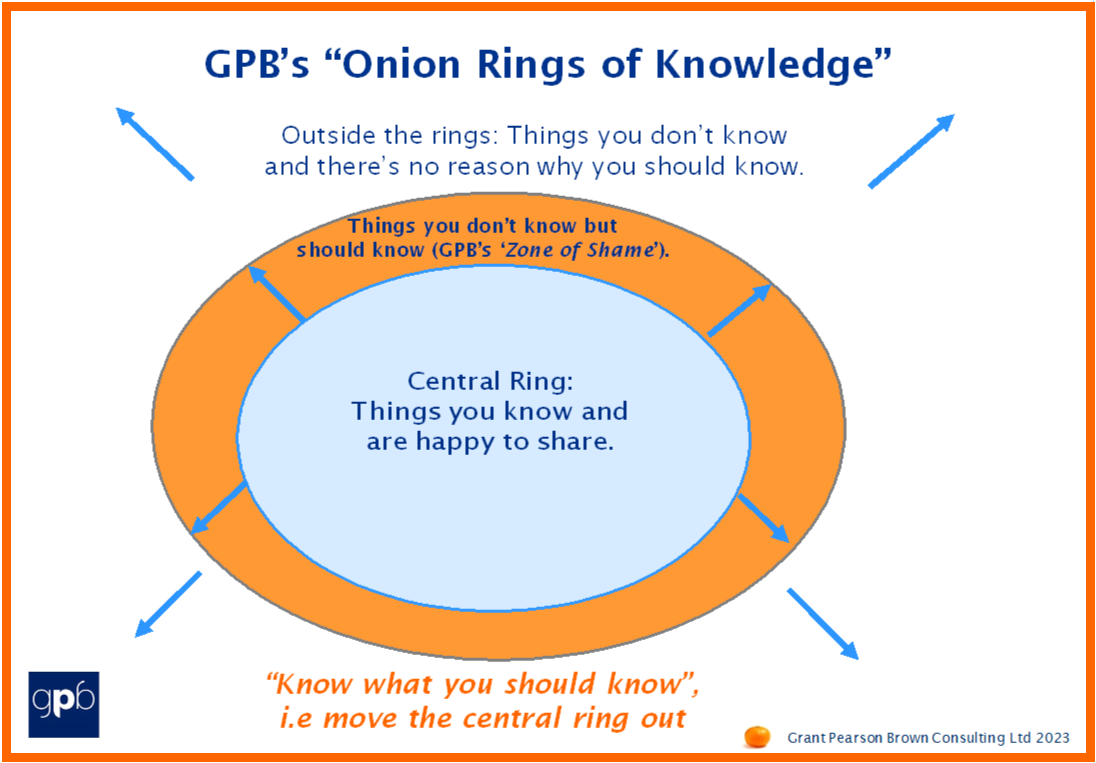
These are tricky; there is loss of face, embarrassment and a big risk that you will guess. Don’t! That is very dangerous especially if you also convey a sense of surety that is unfounded.
Instead of guessing, say you don’t know (be honest), but offer a consolation answer if you have one.
This is what we call a ‘don’t know – do know’ pairing. Then try again to bridge to a point of your own.
There, a few simple tips for RTTQ. Any questions?
By Ewan Pearson