And, “to fail to prepare is to prepare to fail”
Try to imagine that you’ve been obsessed by outer space since childhood. And that deep down, you’ve always wanted to join NASA but just never found time to fill in the application form.
Then, one day, as you’re waiting for an elevator (pretending it’s a space capsule, of course) you notice somebody beside you, also waiting. And then you realise that person is Bill Nelson, Administrator of NASA. What a coincidence! This must be Fate, right? It’s your big chance. Time to give Bill your best shot.
You open your mouth to speak… but then pause, catching flies. Where on earth should you start? You want your words to be relevant, compelling and memorable. You want to seem interesting, credible and competent. To exude gravitas and enthusiasm. And suddenly you wish you had rehearsed more for just this moment.
As you try to think what to say, someone walks up to Bill, takes him by the arm and walks him away towards the coffee lounge. You’ve missed your chance! If only you’d been better prepared, you’re sure Bill would have been fascinated by your story and would have stayed to hear you out. Perhaps enough even to schedule a follow-up meeting.
This is an imagined situation. But there are plenty in the real world where we can benefit from having a strong pre-prepared “elevator pitch”. A short speech that explains what you or your organisation does, the value you add, how you’re different, or some other narrative. It should tell your story clearly and succinctly. It needn’t be for Bill – nor for any specific individual. It could be for use with a senior colleague or other stakeholder. For potential new clients, perhaps. Possibly even for former clients you haven’t seen in some time.
Your elevator pitch should be brief and persuasive, spark interest and influence its recipient. You might need several different versions: to engage people around a specific project, initiative, idea or product – or just in yourself.

NASA’s idea of an elevator. Is somewhat longer than most!
[Photo Credit: NASA]
Wikipedia defines an elevator pitch, speech or statement as ‘a short description of an idea, product, or company that explains the concept in a way such that any listener can understand it in a short period of time… [and] when explaining to an individual… why they would be a productive and beneficial person to have on a team or… project.’1
An elevator pitch should last no longer than a short elevator ride. Hence the name. There are no absolute rules about duration. But it should be short enough to finish before the elevator doors ping open and your target disappears. Perhaps for good. Short enough to gain and maintain their interest. Strong enough for them to want to hear more. Either now or in future. Remember, there are good reasons why a lot of TV commercials run for just 30 seconds or less (other than the cost of air time!)
I’ve recently started some client work in the green manufacturing space, around improving The Elevator Pitches. It’s an unusual request but completely logical as it benefits from some of the same techniques and preparation that can be applied to longer forms of persuasive communication. That client sees the value in being prepared for unexpected opportunities
For instance, take GPB’s ‘7 Rhetorical Canons’ methodology (see image) developed from Classical thinking. We routinely apply this to major presentations. But it’s equally helpful in preparing an elevator pitch. You needn’t worry about the Latin names of the 7 steps outlined. Focus on the action each step suggests.
You should think about:
(1) what your audience should hear;
(2) what the optimal content would be (a few key messages);
(3) how you should sequence it;
(4) what words make your narrative most compelling;
(5) what prompts work best to deliver your pitch; and
(6) how best to handle questions that might arise, when (6) you’ve delivered it. Once you HAVE delivered it, reflect …
(7) on how well it went. How it was received. What parts seemed to work best? What went less well? You can then refine it accordingly/as necessary, for future use.
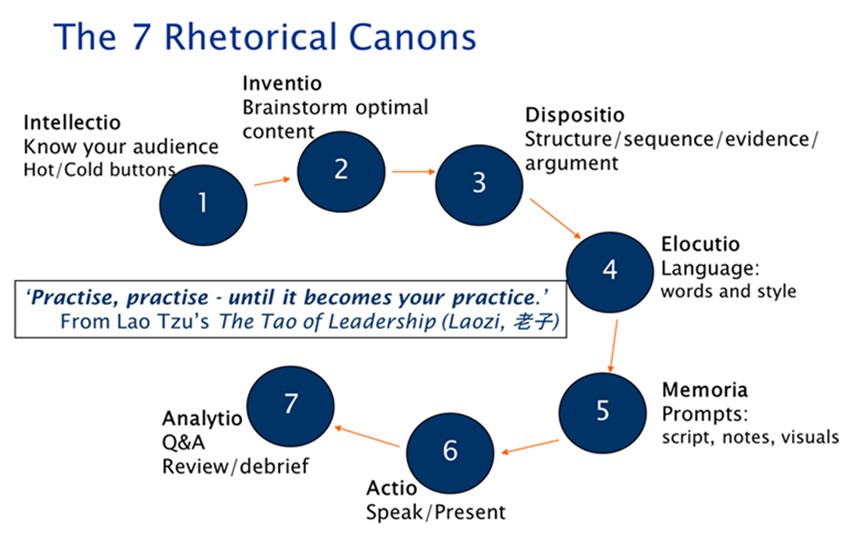
We should never ignore practice, as Lao Tzu’s quote below makes clear. Ask a buddy for feedback. Is the content right? How do you sound and look when you’re delivering it? Use your mobile phone’s camera to film yourself rehearsing. Review it to see for yourself what’s working and what’s not.
That way you can continue improving your pitch. Making it ever more engaging and persuasive. Whether it’s about you, a latest initiative or your business. Or perhaps about how neatly you would fit into NASA’s Artemis Moon Mission programme. Maybe they could use your help. If only Bill knew…
By Des Harney
References/Image sources:
1) https://en.wikipedia.org/wiki/Elevator_pitch
2) Image sources: https://commons.wikimedia.org/wiki/File:Astronaut-EVA_edit_(1).jpg
3) https://commons.wikimedia.org/wiki/File:Artemis_1_SLS_Rollout_(cropped).jpg