
Des shares a favourite source of impactful quotes – and leads us to a seasonal poem
Regular readers may recall I’m a big fan of well-chosen quotations – as are my GPB colleagues. They improve almost any “story” you might care to tell, making it (even) more engaging and persuasive. I collect the best ones as a nerdy hobby. A good sprinkling of these come from one poet, born 450 years ago. You may recognise his more frequently quoted lines, whilst being less familiar with his name, and/or his story (ardent Catholic, then Protestant convert; adventurer, soldier, philanderer, criminal, man of God, royal advisor)1, 2.
John Donne (1572-1631) penned many famous “soundbites”, as we might now call them. Some are so familiar, we could be forgiven for misattributing them to Shakespeare, his more famous and prolific contemporary quotee – born just 8 years earlier.
I was lucky enough to “discover” Donne via English A-level, far too long ago now. As a result, I also made the lucky teenage discovery that his poetry could be surprisingly sensual, for its time – indeed, for any time. I’ve carefully curated for you here a few of Donne’s more familiar phrases. You’ll surely have heard several quoted before. How well and persuasively used, I’ll leave you to judge. You might try quoting one yourself, at a suitable moment, some are more (ahem!) work-appropriate than others3: Here is a sample of Donne quotes:
No man is an Island
Though Truth and Falsehood be / Near twins, yet Truth a little elder is
Reason is our soul’s left hand
Go and catch a falling star (used as the title of Perry Como’s 1957 hit song)
Busy old fool, unruly Sun
Love, all alike, no season knows, nor clime
Who are a little wise, the best fools be
… dear, I die / As often as from thee I go
Love built on beauty, soon as beauty, dies
No spring, nor summer beauty hath such grace / As I have seen in one autumnal face
Come live with me, and be my love (used as the title of Heaven 17’s 1983 hit song)
I wonder, by my troth, what thou and I / Did, till we loved?
For God’s sake hold your tongue, and let me love.
Licence my roving hands, and let them go / Before, behind, between, above, below. / O, my America! my new-found land, / My kingdom
I run to death, and death meets me as fast
What if this present were the world’s last night?
Death, be not proud… / One short sleep past, we wake eternally / And death shall be no more / Death, thou shalt die
never send to know for whom the bell tolls; / It tolls for thee (used as the title of Hemingway’s 1940 novel).
During Donne’s lifetime, public literacy was the exception, rather than the rule. He wrote for a select, elite audience who held “Metaphysical” wit and conceit in high esteem. The complex cleverness, the ‘erudition and ingenuity’4 he deployed to amuse them has helped maintain his literary reputation through the centuries, and still keeps him soundbite-worthy. Coleridge later enthused: ‘To read Dryden, Pope, &c., you need only count syllables; but to read Donne you must measure time, and discover the time of each word by the sense of passion.’5 Even as I write, ‘The Guardian’ is exploring Donne’s ‘Holy Sonnet XIX’ as their Poem of the Week.6
All of which lengthy preamble leads me finally to share with you a seasonal sonnet of Donne’s. Internet searches reveal many Christmas websites and pages quoting from or sharing this. In fact, Donne’s other writings frequently referenced Christmas, too.
As the Dean of London’s St. Paul’s Cathedral, from 1621–1631, his day-job often required him to work through the festive season (unlike many of us) speaking in public.
So we also have the texts of sermons Donne preached from the St. Paul’s pulpit, on various Christmas Days. Here is an example:
‘Tis time that heart and voice be lifted high / Salvation to all that will is nigh.7
Nativity7
Immensity cloistered in thy dear womb,
Now leaves His well-belov’d imprisonment,
There He hath made Himself to His intent
Weak enough, now into the world to come;
But O, for thee, for Him, hath the inn no room?
Yet lay Him in this stall, and from the Orient,
Stars and wise men will travel to prevent
The effect of Herod’s jealous general doom.
Seest thou, my soul, with thy faith’s eyes, how He
Which fills all place, yet none holds Him, doth lie?
Was not His pity towards thee wondrous high,
That would have need to be pitied by thee?
Kiss Him, and with Him into Egypt go,
With His kind mother, who partakes thy woe.
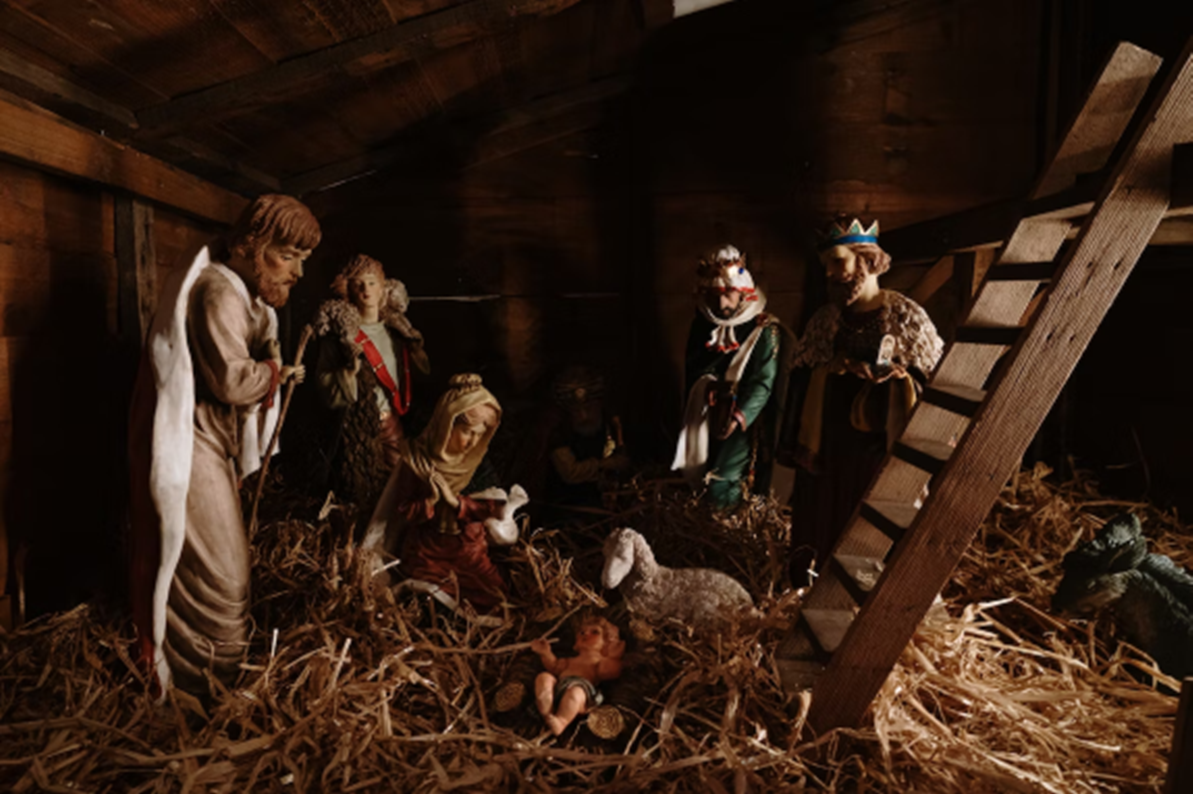
The Nativity. Photo by Al Elmes on Unsplash
How very topical – Merry Christmas!
By Desmond Harney
Sources:
- Donne: The Reformed Soul’ by John Stubbs (W. W. Norton) 2006
- The double life of a poet’ by Michael Schmidt – a review of the above (Stubbs) in The Independent, Books section, 4 Aug. 2006, p. 22
- Lines taken from various poems in ‘The Complete English Poems: John Donne’ (Penguin Classics) 1976
- The Poems of John Donne’ Vol. II, by H. J. C. Grierson (OUP) 1912 – Introduction, pg vii https://resources.warburg.sas.ac.uk/pdf/emh170b2451448B.pdf (digitised in 2007)
- Samuel Taylor Coleridge, “Notes on Donne’s Poems” in Notes, Theological, Political, and Miscellaneous ed. Derwent Coleridge (1853), p. 249
- https://www.theguardian.com/books/2022/dec/05/poem-of-the-week-holy-sonnet-xix-by-john-donne The Guardian, 5 Dec. 2022, Carol Rumens’s ‘Poem of the week’
- From ‘Holy Sonnets, La Corona’ by John Donne, c.1607-1609: #1 Untitled (see final lines); #3 Nativity